1.1 Our Place in Space
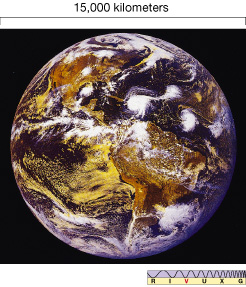
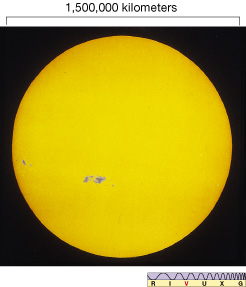
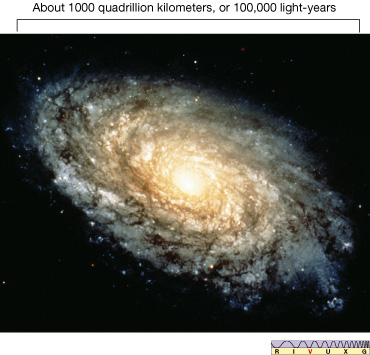
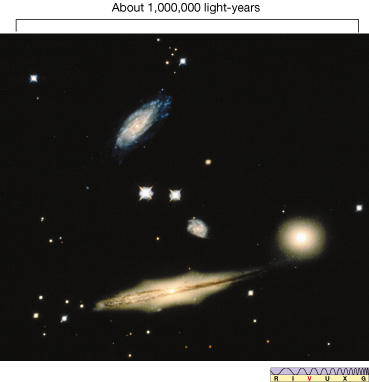
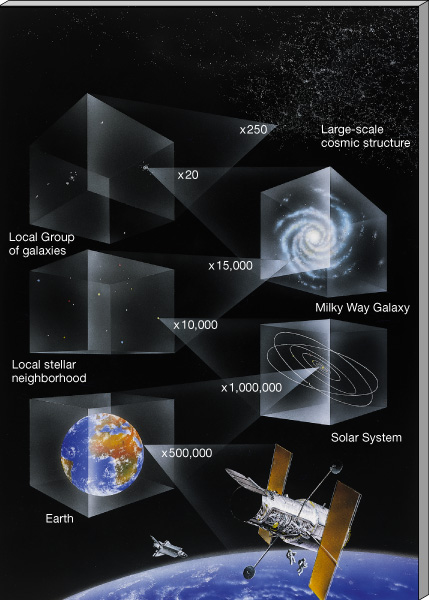
Of all the scientific insights attained to date, one stands out boldly: Earth is neither central nor special. We inhabit no unique place in the universe. Astronomical research, especially within the past few decades, strongly suggests that we live on what seems to be an ordinary rocky planet called Earth, one of nine known planets orbiting an average star called the Sun, a star near the edge of a huge collection of stars called the Milky Way Galaxy, which is one galaxy among countless billions of others spread throughout the observable universe. To begin to get a feel for the relationships among these very different objects, consult Figures 1.1 through 1.4 and put them in perspective by studying Figure 1.5.
 |
 |
|
| Figure 1.1 Earth Earth is a planet, a mostly solid object, though it has some liquid in its oceans and core, and gas in its atmosphere. In this view, you can clearly see the North and South American continents. (NASA) | Figure 1.2 The Sun The Sun is a star, a very hot ball of gas. Much bigger than Earth, the Sun is held together by its own gravity. (AURA) | |
 |
 |
|
| Figure 1.3 Galaxy A typical galaxy is a collection of a hundred billion stars, each separated by vast regions of nearly empty space. This galaxy is the 4414th entry in the New General Catalog of Astronomical Objects—NGC 4414 for short. Our Sun is a rather undistinguished star near the edge of another such galaxy, called the Milky Way. (NASA) | Figure 1.4 Galaxy Cluster This photograph shows a typical cluster of galaxies, roughly a million light-years from Earth. Each galaxy contains hundreds of billions of stars, probably planets, and possibly living creatures. (NASA) |
 |
|
 |
Figure 1.5 Size and Scale This artist’s conception puts each of the previous figures in perspective. The bottom of this figure shows spacecraft (and astronauts) in Earth orbit, a view that widens progressively in each of the next five cubes drawn from bottom to top—Earth, the planetary system, the local neighborhood of stars, the Milky Way Galaxy, and the closest cluster of galaxies. The top image depicts the distribution of galaxies in the universe on scales of hundreds of millions of light-years. The numbers indicate approximately the increase in scale between successive images. (D. Berry) |
Simply put, the universe is the totality of all space, time, matter, and energy. Astronomy is the study of the universe. It is a subject unlike any other, for it requires us to profoundly change our view of the cosmos and to consider matter on scales totally unfamiliar from everyday experience. Look again at the galaxy in Figure 1.3. This galaxy, whose catalog name is NGC 4414, is a swarm of about a hundred billion stars—more stars than the number of people who have ever lived on Earth. The entire assemblage is spread across a vast expanse of space 100,000 light-years in diameter. A light-year is the distance traveled by light in a year, at a speed of about 300,000 kilometers per second. Multiplying, we find that a light-year is equal to 300,000 kilometers/second  86,400 seconds/day 365 days, or about 10 trillion kilometers (roughly six trillion miles). Typical galactic systems are truly "astronomical" in size. For comparison, Earth's roughly 13,000 km diameter is less than 1/20 of a light-second.
The light-year is a convenient unit introduced by astronomers to help them describe immense distances. We will encounter many such "custom" units in our studies. As discussed in more detail in Appendix 1, astronomers frequently augment the standard SI (Système Internationale) metric system with new units tailored to the particular problem at hand.
A thousand (1000), a million (1,000,000), a billion (1,000,000,000), and even a trillion (1,000,000,000,000)—these words occur regularly in everyday speech. But let’s take a moment to understand the magnitude of these numbers and appreciate the differences among them. One thousand is easy enough to understand: At the rate of one number per second, you could count to a thousand in 1000 seconds—about 16 minutes. However, if you wanted to count to a million, you would need more than two weeks of counting at the rate of one number per second, 16 hours per day (allowing eight hours per day for sleep). To count from one to a billion at the same rate of one number per second and 16 hours per day would take nearly 50 years—the better part of an entire human lifetime.
In this book we consider spatial domains spanning not just billions of kilometers but billions of light-years, objects containing not just trillions of atoms but trillions of stars, time intervals of not just billions of seconds or hours but billions of years. You will need to become familiar with—and comfortable with—such enormous numbers. A good way to begin is learning to recognize just how much larger than a thousand is a million, and how much larger still is a billion. Appendix 2 explains the convenient method used by scientists for writing and manipulating very large and very small numbers. If you are unfamiliar with this method, please read Appendix 2 carefully—the scientific notation described there will be used consistently throughout our text, beginning in Chapter 2.